BRENDAN C. A. MENG
As a teacher, I do my very best to model the mindset and accompanying behaviors that declare learning as a life-long endeavor which can always be improved upon as well as improve one's understanding of the world around them. In the case of my classroom that world largely consists of the subject areas of earth science and biology. I do not believe that my students' knowledge acquisition on a topic should end at the moment they finish and submit a unit's summative exam. Instead, I believe in utilizing test corrections as a multifaceted tool to engage learners in analyzing their own assessment results and to help them set immediate goals for their own learning through test corrections. I use this data and self reflection to strategically drive instruction as I plan for re-teaching lessons, which may be as early as the same class period as an exit ticket. Through the process of identifying exactly why a student missed the answer to a question, it not only employs and sharpens one's self-reflection abilities, but also builds confidence in my students for the next time they encounter the types of questions included on a summative end-of-unit exam. I have found the key to successfully employing this strategy is to hold students accountable in preparing for their exam initially while simultaneously engaging students in their own learning. I do this by having a classroom policy that a student may only complete test corrections if they have completed the entire unit study guide prior to the test. Study guides are also excellent formative assessments of student content knowledge prior to the summative assessment. By reviewing student answers and providing descriptive feedback on each student's study guide, I am able to verify and further support my student's learning and academic growth through specific feedback.
The study guide above was completed by a student who chose to complete a study guide for the very first time over halfway through the year. This choice came about by having a conference with them about their previous performance on unit tests, which was an average below 65% (failing), and asking guiding questions like, "what is the point of a study guide?" or, "do you think you would have done better on the test if you had completed a study guide first?" After this meeting the student chose to complete their study guide, and, as they anticipated, received their highest score on an earth science test yet this year.
Above: ZipGrade data for my biology students mitosis and meiosis summative exam. Once students submit their answer sheet, I use ZipGrade to quickly and accurately acquire a score and analyze assessment data for each individual student. The data provided by the app reflects individual student performance per question, allowing me to quickly identify any gaps in learning, data which I use to communicate immediate, functional feedback to each student about their performance. Additionally, I can organize the data to reflect single and multi-class performance, allowing me to identify gaps in learning which inevitably reflect gaps in my own teaching. I use this data and self reflection to strategically drive instruction as I plan for re-teaching lessons, which may be as early as the same class period as an exit ticket. For example, my biology students most missed questions on their Mitosis Meiosis Exam were questions 20 and 19, with 3 and 9 close behind, as displayed by the data below which consists of both initial assessment data as well as student corrections data. These questions were some of the first reviewed the following class followed by a formative online assessment thereafter. This data also proves invaluable when planning end of year remediation lessons and materials per individual student.

The item analysis and student summative assessment answer sheet above are screenshots of the types of data immediately available to me upon scanning a student's completed assessment via the ZipGrade phone app. In this case, the student missed four times the amount of questions on mineral unit-based questions than they did rock unit questions, which begin at question number 18. Upon conferencing with the student, we discovered the possible cause of this learning gap. The student had missed two consecutive days and not picked up their missed work which consisted of guided notes and reading comprehension assignments on 3 of the 4 mineral unit questions missed. For test corrections, I believe it is best to complete test corrections immediately while the material is still fresh on student's minds rather than waiting until the next class period two days away. Additionally, the immediate feedback provides students with a motivation towards an opportunity to improve their academic success by correcting misconceptions.
Upon receiving and scoring each student answer sheet I highlight the questions they missed on their answer sheet and hand the test back to them with the instructions to review the highlighted questions and seek to understand why the correct answer was not chosen. This routine displays my commitment to engaging my learners actively in the assessment process as they then seek to review and further develop their learning capacity in addition to being an example of my commitment to providing timely and effective feedback to learners on their progress. Students become very familiar with this routine procedure after just one or two assessments.


Above: Several examples of student corrected assessments throughout the year. The first attempt by a student at a summative assessment is displayed to the left and their corrections to the right in each of the above images. The students who most benefit from this accommodation of assessment are those who initially score the lowest on their first attempt as they have the greatest room for growth, such as those students' answer sheets pictured first, third, and fifth above. Students who initially perform at a high level also have something to gain as this process engages them in examining their own thinking and allows them to actively engage in the assessment process to develop their capacity to review and communicate about their own progress and learning.
Above: Corrected answer sheets from various summative assessments this year in both my earth science and biology classes. As mentioned before, accountability for this classroom routine is key for success for both me and my students. As such, I allow my students to regain up to half of the points missed on their initial attempt. In order to maximize positive feedback and maintain student motivation and ownership of their grade, I submit both scores holding the same weight into my gradebook, correct the score, and pass back each student answer sheet for their records and future reference. Assessment booklets are posted to each class's section of Schoology so they can access the test to identify the questions they are still struggling with.
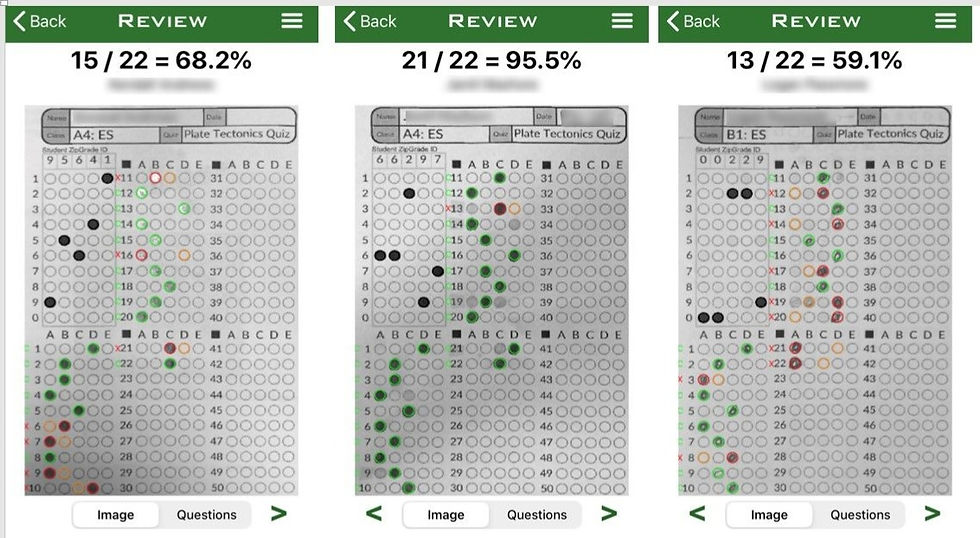
Here are three examples of student plate tectonic quizzes. I do not allow test corrections for quizzes, instead I assess each classes data to identify the most missed questions throughout the class and create a most missed questions exit ticket for each class as a way to actively engage learners in the assessment process and develop each learner's capacity to review and communicate about their own progress and learning.

Here is the ZipGrade analysis of my B1 earth science class. I employ this appropriate technology as a way to support assessment practice both to engage learners more fully and to assess and address learner needs more accurately and quickly.

My A4 class most missed plate tectonics quiz questions included questions 19 and 21, similar to my B1 class. This data clearly identifies a learning gap relating to the layers of the earth and their characteristics. Data that allows me to identify learning gaps and make deliberate instructional choices moving forward is an invaluable tool of my pedagogy.
Here are three examples of student plate tectonic quizzes. I do not allow test corrections for quizzes, instead I assess each classes data to identify the most missed questions throughout the class and create a most missed questions exit ticket for each class as a way to actively engage learners in the assessment process and develop each learner's capacity to review and communicate about their own progress and learning.